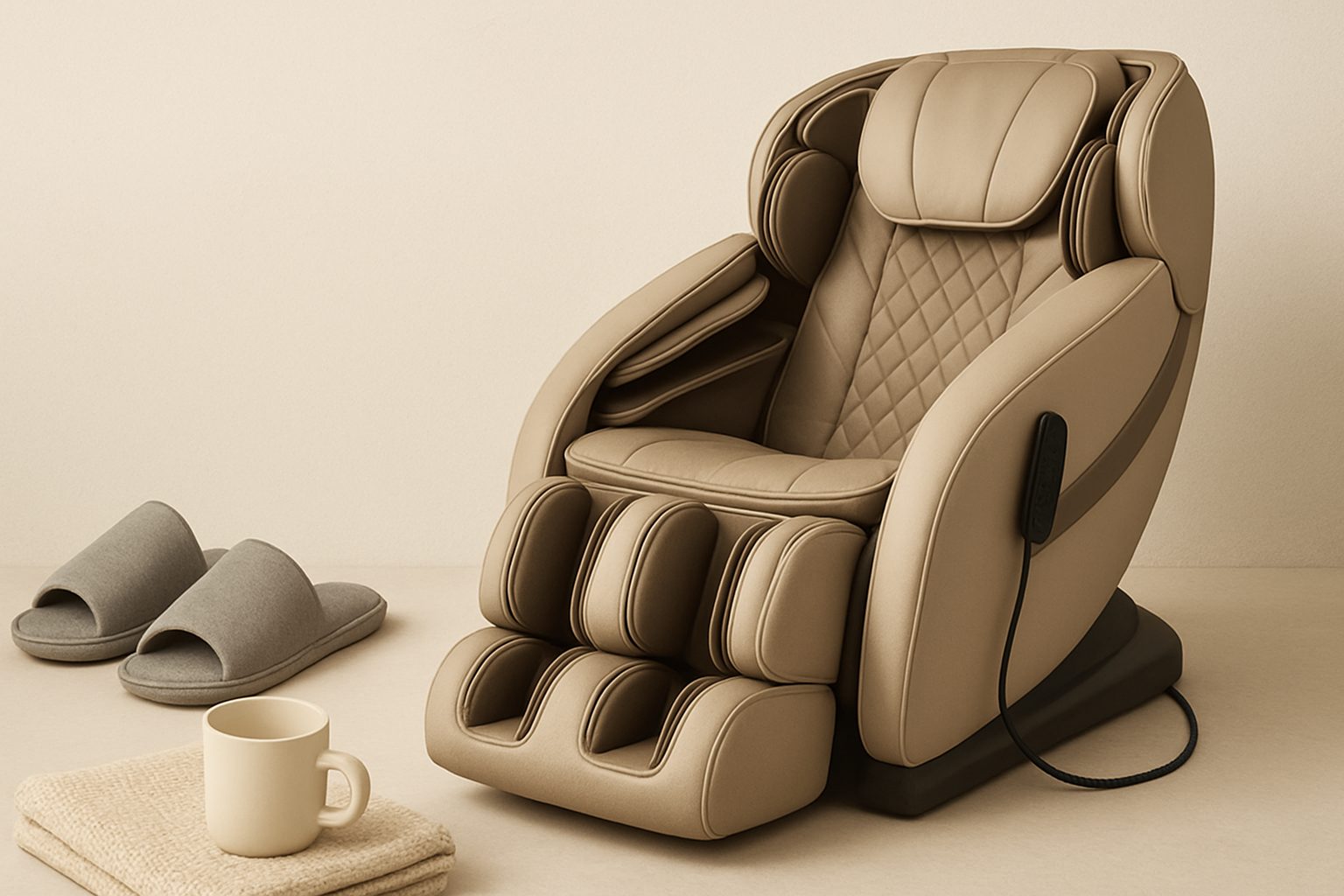
How Do Massage Chairs Work? Rollers, Airbags & Body Scanning Explained
Massage chairs can feel like magic when you first sit in one—mechanical rollers knead your back, airbags squeeze your limbs, and heat warms your muscles. But there's genuine engineering behind that sensation. Understanding how the different systems work helps you evaluate which chair suits your needs and what to actually expect from the technology.
The Roller System: S-Track vs L-Track vs 3D/4D
The backbone of any massage chair is its roller mechanism. This determines how effectively the chair reaches different areas of your body and how customisable the massage depth is.
S-track rollers follow the natural curve of your spine in a shallow S-shape, typically covering your neck down to your mid-back. They're gentler and more compact, found in entry-level and mid-range chairs. The rollers move vertically up and down this track, delivering a straightforward kneading motion. If you mostly want basic neck and upper-back relief, S-track is usually adequate.
L-track rollers extend further down your body, running from the neck all the way to the lower back and sometimes into the glutes and thigh area. The longer coverage is genuinely useful if you sit at a desk all day and hold tension throughout your entire back. L-track chairs take up more space and tend to cost more, but the extended reach justifies it for many people.
3D and 4D rollers add complexity beyond the basic up-down motion. A 3D system lets the rollers move not just vertically but also protrude outward and inward from the track—essentially adding depth adjustment so you can control how intensely the rollers dig into your muscles. 4D goes further, adding side-to-side movement as well, creating a more natural, multi-directional massage that mimics what a human massage therapist's hands do.
The difference between 3D and 4D is noticeable but not revolutionary for most users. If a chair is expensive primarily because of 4D technology, you're often paying for diminishing returns.
Air Compression: Squeezing Tension Away
Whilst rollers handle the spine, airbags handle everything else. Massage chairs contain dozens of airbags distributed across the armrests, seat, legs, and sometimes the shoulders. These inflate and deflate in sequences to apply pressure—a technique called compression massage.
The airbags work on a simple principle: inflate to apply pressure, deflate to release. But the sequencing matters. A good air compression system inflates airbags in overlapping waves, moving pressure from one area to the next. This mimics the rhythm of actual massage and feels more natural than all the airbags simply inflating at once.
You'll typically find:
- Shoulder and arm airbags that squeeze your upper limbs from shoulder to wrist
- Seat airbags that apply pressure across your hips and backside
- Calf and foot airbags that work their way up your lower legs
Most chairs let you adjust the air pressure intensity. Higher intensity isn't always better—too much pressure can feel uncomfortable, especially if you have sensitive skin or circulation issues. Mid-range intensity usually feels most therapeutic.
Body Scanning: Custom Massage to Your Shape
This is where modern massage chairs get clever. Many mid-range and premium models include body-scanning technology. Before the massage starts, the chair uses sensors to map your body's dimensions and contours—essentially taking a 3D snapshot of how you're positioned.
The chair then uses this data to calibrate where the rollers should focus and how much air pressure different body areas should receive. If you're taller or broader than average, the chair adjusts the massage zones accordingly. If you lean to one side, the system adapts.
It's not magic, but it's thoughtful engineering. A chair without body scanning applies the same fixed massage pattern to every user, which is less effective if you don't match the "average" body size the designer assumed. With scanning, the experience is more personalised.
How These Systems Work Together
An effective massage chair orchestrates all three systems simultaneously. You might have:
- Rollers working their way down your spine with adjustable depth (3D/4D)
- Shoulder airbags squeezing whilst the rollers reach your upper back
- Calf airbags engaging in sequence to push blood flow upward through your legs
- Heat warming your lower back whilst compressions ease tension elsewhere
- All of this choreographed to run for 15-30 minutes on a repeating cycle
Most chairs offer multiple pre-programmed routines—a "full body" setting, a "shiatsu" setting, a "relaxation" setting—each with different timings and intensities. You can usually override these and customize individual components manually.
The Limits Worth Knowing
Massage chairs do what they do well, but they're not physiotherapy. They're genuinely relaxing and can ease everyday muscle tension, but they can't fix postural problems, replace stretching, or treat genuine injuries. A chair also can't replicate the adaptive responsiveness of a human therapist who feels where you're holding tension and adjusts in real time.
The sensation can feel odd the first few times, especially if you're sensitive to vibration or pressure. It typically takes 3-5 sessions before most people find the experience genuinely pleasant rather than strange.
If you're considering a massage chair for your home, focus on which combination of features—roller track design, air compression pattern, and body sensing—addresses your specific tension points. That specificity matters more than raw price or brand reputation.
More options
- Amazon UK – Best Massage Chairs (General) (Amazon UK)
- Amazon UK – Zero Gravity Massage Chairs (Amazon UK)
- Amazon UK – Shiatsu Massage Chairs (Amazon UK)
- Amazon UK – Budget Massage Chairs Under £500 (Amazon UK)
- Amazon UK – Luxury & Premium Massage Chairs (Amazon UK)